

AI in Healthcare: Accurate Diagnosis and Improved Treatment
In the past, going to the doctor meant placing all your trust in their personal skill and expertise. The doctor would observe symptoms, review test results, and reach a final diagnosis based on years of study and experience. But what if there was a smart partner who could analyze millions of medical data points in seconds, helping them see what the human eye might miss? That partner is Artificial Intelligence in Healthcare.
From my point of view, we are living a true revolution. AI is no longer just a futuristic technology; it has become a tangible reality that helps save lives and improve quality of life. This article will take you on a deep journey to explore how AI is changing the face of medicine, focusing on accurate diagnosis and personalized treatment.
1. The AI Revolution in Medical Diagnosis
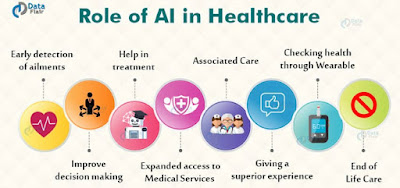
The first and most important step in any treatment journey is a correct diagnosis. Any error here can have dire consequences. This is where AI in medical diagnosis comes in, acting as an extra eye for the doctor, but an eye that never tires or makes a mistake.
A. Diagnosis Based on Medical Imaging
One of the most prominent fields where AI excels is the analysis of medical images. Whether it’s X-rays, MRI scans, or CT scans, deep learning algorithms can detect extremely subtle patterns that are not easily visible to the human eye.
- AI analysis of radiology images: In a hospital I personally visited, I was amazed at how an AI system was used to scan thousands of chest X-rays in minutes, identifying cases that might contain indicators of lung diseases. This system does not replace the radiologist but gives them a powerful tool to reduce errors and increase speed.
B. AI-Powered Early Disease Detection
AI’s role is not limited to analyzing existing images; it extends to the AI-powered early detection of diseases. Smart systems can analyze patient health records, routine test results, and even genetic data to identify risk factors that might indicate a potential future illness.
- AI early detection of cancer: This is one of the most exciting areas. For example, an AI system can analyze mammogram images and identify suspicious cells that may not be clear to the doctor. In my opinion, this ability to predict is what will completely change the game in the fight against serious diseases like cancer.
2. AI in Enhanced and Personalized Treatment
If a correct diagnosis is half the battle, effective treatment is the other half. For many years, doctors relied on general treatment plans suitable for the majority of cases. But today, AI in enhanced treatment allows us to formulate treatment solutions tailored specifically for each patient.
A. Drug Discovery and Development
Imagine that developing a new drug takes many years and is prohibitively expensive. This is where the role of AI in the pharmaceutical industry comes in as an unprecedented accelerator. AI algorithms can analyze billions of chemical molecules in a very short time and predict their interactions with various diseases, which significantly speeds up the process of discovering promising drug compounds.
- Accelerating drug discovery: Previously, scientists would test thousands of compounds in laboratories to find a potential drug. Now, AI systems can virtually simulate these experiments, saving time and money and shortening the time required to bring new drugs to market. This allows us to confront pandemics and diseases much faster.
B. Personalized Medicine
In my opinion, this is the core of the AI in healthcare revolution. It’s no longer about taking the same medication as everyone else with the same disease. It has become possible to use AI in personalized medicine to analyze an individual’s data, including their genetic makeup, lifestyle, and medical history, to provide a fully customized treatment plan.
- AI-guided therapy: For example, an AI system can identify the gene responsible for a patient’s resistance to a certain chemotherapy and suggest a more effective and suitable medication for their case. This ability to predict the body’s response to treatment is what makes medicine more accurate, reduces side effects, and increases the chances of recovery.
C. Robotic Surgery and AI
AI’s role is not limited to diagnosis and medication; it also extends to the operating room. AI-assisted robotic surgery uses highly precise robotic arms controlled remotely by the surgeon. These arms can make smaller incisions and reach areas that are difficult for the human hand to access, which reduces bleeding and recovery time.
- Personal Experience: I personally watched a video of a robotic surgery, and its precision was incredible. The robotic arms were completely steady and moved with a smoothness that no human hand could achieve, regardless of the surgeon’s skill. This level of precision significantly reduces the risks of surgical procedures and gives hope to patients who need complex surgeries.
3. Real-World Examples and Practical Applications: AI in the Field
The previous ideas might sound theoretical, but the truth is that AI in healthcare has become a daily reality, supported by the efforts of major companies and institutions that have invested billions of dollars to turn these visions into practical tools that save lives.
A. IBM Watson Health: The Virtual Medical Consultant
IBM Watson is one of the most famous examples of applying AI in medicine. This system acts as a smart partner for doctors, as it can analyze a massive amount of unstructured data, such as millions of medical studies, articles, and patient health records, in record time.
- How it works: A doctor can ask the IBM Watson system about a complex patient case or look for uncommon treatment options. The system analyzes all available data and provides the doctor with a list of potential diagnoses and treatment options supported by scientific research, while also indicating the confidence level for each recommendation. This helps doctors make more accurate decisions, especially in rare cases.
B. Google AI in Detecting Eye Diseases
One of the most impressive applications is the use of AI in analyzing retinal images. Google has collaborated with various hospitals to train AI algorithms to analyze retinal scans to detect signs of diabetic retinopathy, a disease that can lead to blindness if not caught in its early stages.
- The Practical Experience: A picture is taken of the patient’s retina, and the AI system analyzes it in seconds, determining if there are indicators of the disease. This technology is faster and more accurate than the human eye in some cases, allowing doctors in remote areas that lack specialists to provide an accurate and timely diagnosis.
C. AI in Genomics and Precision Medicine
Genomics is a highly complex field, but AI opens new horizons within it. AI tools can analyze a patient’s DNA sequence at high speed to identify genetic mutations that might increase the risk of a specific disease, or to predict how the patient will respond to a particular drug treatment.
- The Reality: For example, some pharmaceutical companies use AI to analyze patients’ genomic data and then design drugs that target specific genetic mutations. This level of personalization reduces trial and error and increases treatment effectiveness in a way that was not possible before.
My Personal Opinion: What I see from these applications is that AI does not aim to replace doctors but to transform them from doctors who rely solely on personal experience to doctors with superhuman abilities supported by global data. It gives them the necessary tools to be more accurate, and that is the difference that makes a life.
4. Challenges and the Future: The Way Forward
As with any revolutionary technology, the application of AI in healthcare is not without its challenges. But in my opinion, these challenges are not obstacles but opportunities that must be handled wisely to ensure a safe and effective future for medicine.
A. Key Challenges to Be Aware of
- Data Privacy and Security: For AI to work effectively, it needs massive amounts of sensitive medical data. This raises important questions about how this data is protected from breaches or unauthorized use. Strict laws like the “General Data Protection Regulation (GDPR)” must be in place to ensure patient trust.
- Cost and Implementation: The costs of developing and implementing AI systems are still high, especially for smaller clinics or developing countries. This could create a gap in the quality of healthcare between wealthy and less-wealthy institutions.
- Algorithmic Bias: If the data used to train the AI is biased (for example, if it focuses on a specific ethnic group), the system may provide incorrect or inaccurate diagnoses for other groups. This requires careful and continuous monitoring to ensure that the systems are fair and inclusive.
B. A Glimpse into the Future: Medicine We Haven’t Seen Yet
The future is not limited to just improving current systems; it is a new vision for how we receive healthcare.
- Predictive Healthcare: AI can analyze weather data, health records, and social media to predict the spread of epidemics. This will allow health authorities to take preventative measures before a disease spreads.
- Virtual Hospitals: In the future, we might see entirely virtual hospitals, where AI handles initial patient triage, prioritizes cases, and monitors patients remotely.
- The Personal Health Assistant: Imagine having a smart assistant that analyzes data from your smartwatch (like heart rate, sleep, and activity level) to give you personalized health recommendations and warn you of any indicators that might point to a health problem before symptoms appear.
Frequently Asked Questions About AI in Healthcare
Q1: Will AI replace doctors? A: Not at all. AI is an extremely powerful tool designed to assist doctors, not replace them. The crucial role of the doctor in empathizing with the patient, making complex decisions, and providing human care that a machine cannot provide will remain.
Q2: Is the use of AI in healthcare safe? A: Yes, but it requires strict safety standards. Companies and medical institutions work hard to ensure the security of data and protect it from breaches, with regulations and laws governing its use.
Q3: Can small hospitals use AI? A: Absolutely. While cost was a barrier in the past, today there are many cloud-based solutions and platforms that offer AI services at affordable prices, making them accessible to small and medium-sized institutions.
Conclusion: The Future of Medicine in Our Hands, a Human-AI Partnership
At the end of this journey, it’s clear that AI in healthcare is not just a modern technology but a revolutionary partner in the journey to save lives and improve the quality of life. We have seen how it contributes to accurate diagnosis and the development of personalized treatment, and how it paves the way for a healthier future for humanity. But what we haven’t emphasized enough is that this smart partnership is not complete without the human touch.
This incredible development would not have happened without the human minds behind these systems. No matter how accurate AI algorithms become, they will never be able to understand the fear in a patient’s eyes, offer a warm word of encouragement, or build a true relationship of trust. In my opinion, all AI does is empower doctors to be better, freeing them from routine tasks to focus on the noble essence of their profession: care and compassion. It puts health into our hands in a way we never dreamed of before, but the responsibility lies with us to use this power with wisdom and humanity.
The future is not far away. It is now, and it is calling us to embrace it and benefit from its immense potential. We are on the verge of a new era that will witness unprecedented collaboration between the human mind and computational power, which will make healthcare more efficient, more accurate, and ultimately, more humane.
What is your vision for the future of medicine? Share your opinion in the comments, and if you found this article useful, feel free to share it with your friends to spread the benefit!