

In the world of artificial intelligence, technological dominance is no longer measured solely by parameter count or model size—it’s now defined by who owns the vision, the infrastructure, and sovereign control over their tools. While the United States leads the global scene with models like ChatGPT and Microsoft Copilot, China is moving in a completely different direction—not to imitate, but to build an independent ecosystem that redefines AI from the ground up.
Amid this shift, Wudao 3.0 emerges as more than just a language model. It is a national project, state-backed, built on a modular architecture known as Aquila, and actively deployed across education, industry, and media. It’s not presented as a public-facing tool, nor marketed globally—it operates within China as a sovereign asset, reflecting a new philosophy: artificial intelligence is not merely a product… it is national infrastructure.
In this article, we dive into the details of Wudao 3.0: how it works, what sets it apart from Western models, and what limitations currently hinder its global expansion.
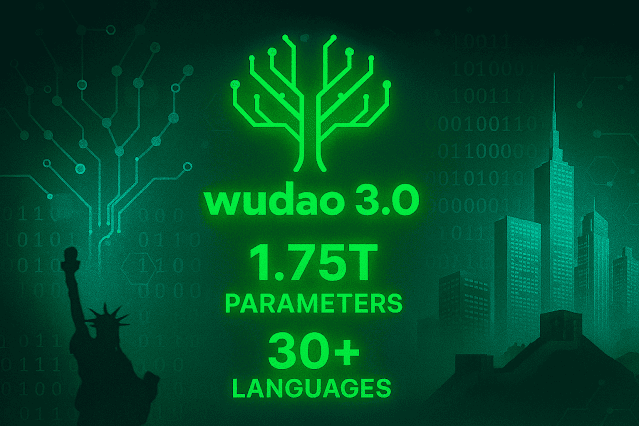
China and Artificial Intelligence: From Consumption to Digital Sovereignty
By 2025, China is no longer just a player in the AI market—it has become a strategic force reshaping the global innovation landscape. According to a report by Bank of America, China’s AI spending this year is expected to reach between 600 and 700 billion yuan, equivalent to $84 to $98 billion, marking a 48% increase over 2024. This figure clearly reflects the country’s political and economic commitment to this vital sector.But this investment goes far beyond developing language models like Wudao 3.0 and DeepSeek-V3. It also includes:Digital infrastructure: Building massive data centers and expanding supercomputing networks to efficiently run modular models.Domestic chip production: Supporting companies like Cambricon and Huawei to reduce reliance on Western chips and enhance technological independence.Sector-wide applications: Deploying AI in education, healthcare, security, and autonomous vehicles, with over 200 institutions already using Wudao internally.Ethical and sovereign standards: Developing national policies to regulate AI usage in line with Chinese values and maintaining internal stability.According to the China Academy of Information and Communications Technology, the number of AI companies in China surpassed 5,300 by September 2025, accounting for 15% of all AI companies worldwide. These firms aren’t just competing on performance—they’re redefining AI as a domestically governed tool used to build a sovereign, integrated ecosystem.Other reports suggest that China plans to surpass the United States in this field by 2030—not just in model count, but in full-cycle control over AI: from infrastructure to applications, from training to deployment.📌 Read also : 🤖 What Is Artificial Intelligence? A Comprehensive and Simple Guide for BeginnersThis transformation shows that China is no longer content with consumption or imitation—it is producing, competing, and redefining artificial intelligence as a sovereign tool for building a technologically and economically independent future.
What Is Wudao 3.0—and Why Does It Matter?
Developed by the Beijing Academy of Artificial Intelligence (BAAI), Wudao 3.0 is one of the largest language models in the world. Its third iteration, announced in July 2023, marks a strategic shift from a single massive model to a modular system known as Aquila.
This shift is not just technical—it’s tactical. Instead of relying on massive resources that are increasingly restricted by U.S. chip sanctions, China opted for smaller, more efficient, and customizable models.
Wudao supports over 30 languages and is actively used in education, healthcare, media, and industry. However, it’s not publicly available through an open interface. It operates within closed environments, reflecting a move toward sovereign AI infrastructure.
Key Advantages of Wudao 3.0: Strategic Features That Matter
Wudao 3.0 isn’t just a language model—it’s part of a national vision for AI sovereignty. Here are its standout strengths:
- Parameter Count: The previous version of Wudao boasted 1.75 trillion parameters, compared to 175 billion in GPT-3. While Wudao 3.0 uses smaller modular models, performance remains strong due to smart task distribution.
- Modular Architecture (Aquila): The model is split into specialized units like AquilaChat for dialogue and AquilaCode for code generation, reducing energy consumption and enabling easy customization.
- Multilingual Support: With support for over 30 languages, Wudao is already deployed in cross-sector applications across China.
- Partial Open Source: Some components are open to Chinese universities and companies, allowing them to build on top without external licensing.
- Chip Independence: Designed to run on architectures less reliant on U.S. chips, Wudao is more resilient to geopolitical constraints.
These features make Wudao 3.0 not just a model—but a scalable platform for building sector-specific AI tools.
📌 Read also : 📊 a16z Report Reveals the Most Used AI Tools by Startups
Limitations of Wudao 3.0: Barriers to Global Expansion
Despite its strengths, Wudao 3.0 faces clear challenges—especially when compared to GPT-4 or Claude in global contexts:
- No Public Interface: The model isn’t available via website or API, making it hard to evaluate or test outside China.
- Content Censorship: Wudao is subject to strict political filtering, limiting its use in open environments.
- Lack of Global Documentation: There’s little technical documentation or independent benchmarking available internationally.
- Export Challenges: China hasn’t yet released a commercial version for global use, keeping Wudao confined to domestic deployment.
- Domestic-Only Adoption: The model is used in Chinese universities and enterprises but remains inaccessible to global developers.
These limitations don’t diminish Wudao’s importance—but they show it’s still in a localization phase, not yet ready for global rollout.
DeepSeek: China’s Second Arm in the AI Race
Alongside Wudao, DeepSeek has emerged as one of China’s most advanced models in 2025. Known for deep comprehension, accurate translation, and specialized content generation, it’s used in education, finance, and healthcare.
According to recent reports, China is expected to invest up to $98 billion in AI this year alone. This massive funding isn’t just about catching up—it’s about reshaping the global AI market and positioning Chinese models as viable alternatives to American ones.
📌 Read also : 🇨🇳 China Leads the AI Race: Over 5,300 Companies in 2025
My Personal Take as a Daily User of ChatGPT and Copilot
As a blogger and content strategist, I use ChatGPT and Microsoft Copilot daily. ChatGPT gives me flexibility in idea generation, while Copilot helps me structure articles, manage visuals, and conduct live research.
But despite relying on them, I can’t ignore what’s happening in China. Beijing isn’t just building tools—it’s crafting a comprehensive AI ecosystem, driven by strategic vision and rapid development.
I believe China isn’t just competing on performance—it’s aiming for full-cycle control over AI: from infrastructure to models, from applications to policy.
❓ Frequently Asked Questions About Wudao 3.0
① Can Wudao 3.0 be used outside China?
No. The model isn’t available through any public interface or global API. It’s used only within closed Chinese environments.
② Is Wudao 3.0 open source?
Partially. Some components like AquilaChat are accessible to registered researchers in China, but require official approval.
③ Does Wudao 3.0 support multilingual tasks?
Yes. It supports over 30 languages and is actively used in cross-sector applications.
④ Can it be compared to GPT-4?
Architecturally, Wudao uses modular models while GPT-4 is unified. Performance is comparable in some tasks, but Wudao lacks global benchmarks.
⑤ Is China planning to export the model?
No official plans yet, but regional expansion may begin through Asian partnerships or government platforms.
📌 Read also : 🧠 Are We Living Through an AI Bubble? A Personal Analysis of Hype vs. Reality
Final Thoughts: Wudao Is More Than a Model—It’s a Message
What makes Wudao 3.0 significant isn’t just its technical specs—it’s the message it sends: China is no longer a consumer. It’s a producer, a competitor, and a rule-maker.
While I continue to use ChatGPT and Copilot in my daily workflow, I can’t ignore the possibility that Chinese models may soon surpass GPT and Claude—not just in performance, but in global influence and standard-setting.
If China maintains this momentum, Wudao and DeepSeek won’t just be tools—they’ll be milestones in the global history of artificial intelligence.